

detector-to-scout-distillation
Companion code for the paper:
Boxes to Scores: Distilling Box-Supervised Defect Detectors into Compact Image-Level Anomaly Scouts
1. What this is
Industrial inspection lines ultimately need one image-level decision — pass or flag — yet the most accurate defect models are box-supervised detectors: annotation-hungry to train and larger than the deployment slot they must fill. This repository implements the paper's recipe for transferring the knowledge inside such a detector across tasks: from box-level detection into a compact student that outputs only an image-level anomaly score and runs without its teacher.
The pipeline has three stages, and this repo ships one command per stage:
your detector (any) ──run once──▶ predictions JSONL          (outside this repo)
                                        │
                       [1] build_targets.py                  cached predictions → per-image
                                        │                    pseudo-box target records
                                        ▼
                       [2] train.py                          Hungarian matching assigns targets to
                                        │                    the student's 100 queries; matched-query
                                        │                    losses + image-label BCE train the
                                        │                    compact multi-scale student
                                        ▼
                       [3] infer.py / export_onnx.py         teacher-free deployment: one forward
                                                             pass, one scalar score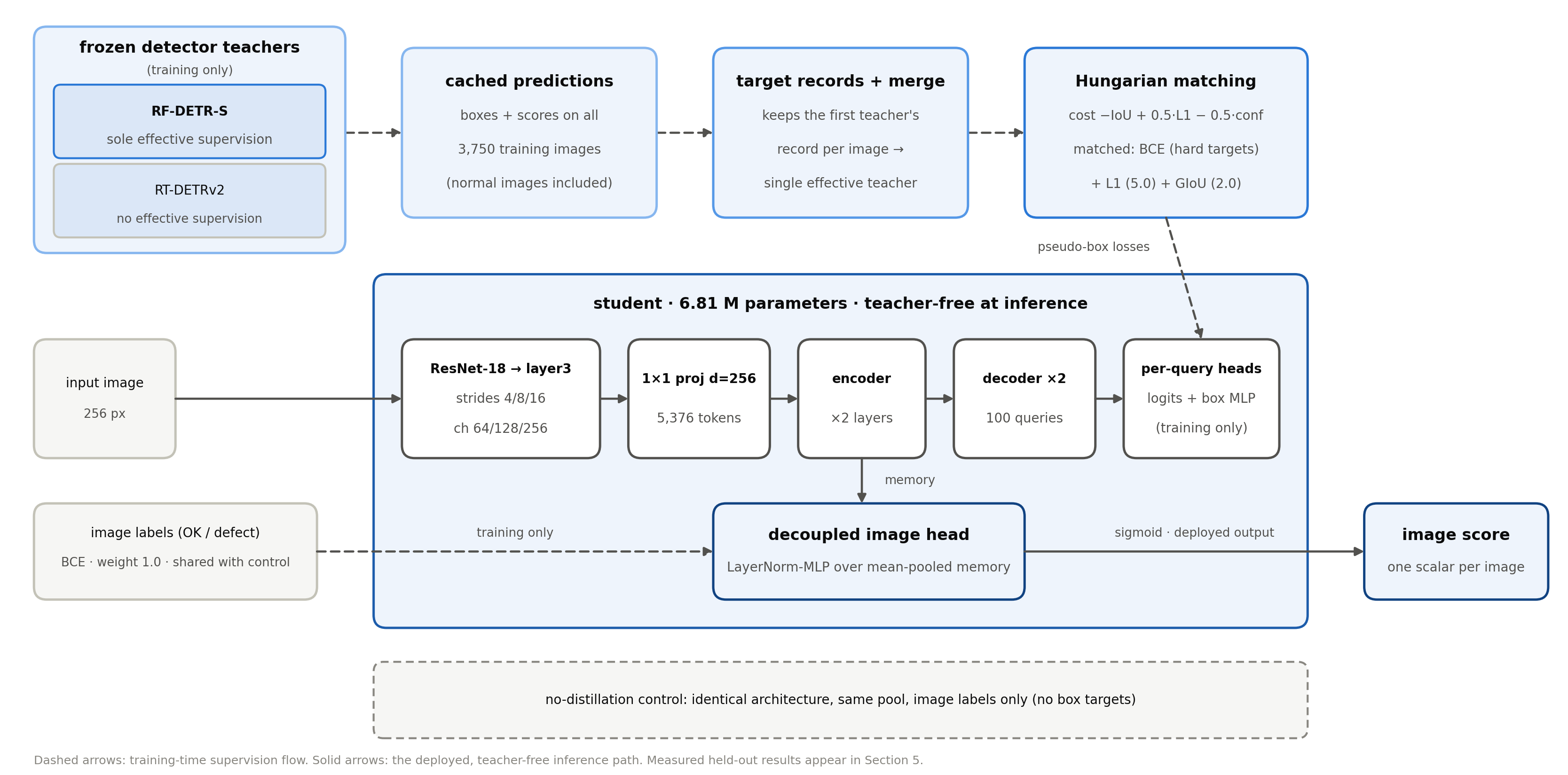
The student ("RT-Scout") is a 6.81 M-parameter multi-scale transformer: a truncated ResNet-18 backbone (strides 4/8/16), a 2-layer encoder over 5,376 tokens, a 2-layer decoder over 100 queries, and — the deployed output — a decoupled image head whose sigmoid over the mean-pooled encoder memory is the image-level anomaly score. The per-query class/box heads exist to consume the distillation losses; they are training scaffolding, not deployed outputs.
Everything here mirrors the implementation actually measured in the paper (Section 3, "as implemented"), including two facts a cleaner idealisation would hide: the classification targets are hard pseudo-boxes (teacher confidences are stored but not propagated into the loss), and the paper's two-teacher merge was first-seen-wins (effectively single-teacher; see §4 below).
2. Install
python -m venv .venv && source .venv/bin/activate
pip install -r requirements.txtRequirements: Python ≥ 3.10, torch, timm, scipy, numpy, pyyaml, pillow, plus onnx / onnxruntime for export. A CUDA GPU is strongly recommended for training (the paper's 30k-step recipe); --device cuda fails loudly if no GPU is reachable — there is no silent CPU fallback.
Quick end-to-end smoke test (synthetic data, ~20 training steps):
python examples/make_dummy_dataset.py --out /tmp/scout_dummy
python -m detector_to_scout.build_targets \
    --manifest /tmp/scout_dummy/train.jsonl \
    --predictions /tmp/scout_dummy/teacher_predictions.jsonl \
    --teacher synthetic_teacher \
    --out /tmp/scout_dummy/targets/teacher_targets.jsonl
python -m detector_to_scout.train \
    --config /tmp/scout_dummy/smoke_config.yaml \
    --run-dir /tmp/scout_dummy/run --max-steps 20 --device cuda
python -m detector_to_scout.infer \
    --checkpoint /tmp/scout_dummy/run/final_state.pt \
    --manifest /tmp/scout_dummy/val.jsonl --device cuda --out /tmp/scout_dummy/scores.jsonl
python -m detector_to_scout.export_onnx \
    --checkpoint /tmp/scout_dummy/run/final_state.pt \
--out /tmp/scout_dummy/rt_scout.onnx --verify3. Data + teacher contract
No datasets are included. You bring (a) images with binary normal/defective labels and (b) a box-supervised detector's predictions over the training images.
3.1 Images manifest (JSONL)
One record per image, in train.jsonl / val.jsonl:
{"image_id": "grid_0001", "image_path": "images/grid_0001.png", "label": "ok"}
{"image_id": "grid_0107", "image_path": "images/grid_0107.png", "label": "nok"}image_path— absolute, or relative (resolved against the CWD first, then against the manifest file's directory).label—"ok"(normal) or"nok"(defective). This is the binary label consumed by the image-level BCE term.image_id— optional (defaults toimage_path); must match the id used in the targets JSONL.
MVTec-AD pointer. The paper's experiments use MVTec AD (download it yourself; check its license). Build manifests by walking the category folders: good images → "ok", defect images → "nok". Do not train on MVTec-AD's official test split if you plan to evaluate on it — see the leakage warning below.
Custom datasets. Any image folder works: write the two manifest files, keep a held-out val/test split that never enters training, and make sure label is filled for every record (the image-level BCE needs it; the paper's teachers emit boxes on every image, so box presence carries no label information).
3.2 Teacher-predictions contract (JSONL) — any detector can be the teacher
Run your detector once over the training images only and dump one JSON object per line:
{"image_path": "images/grid_0107.png",
"boxes": [{"xyxy": [412.0, 105.5, 468.2, 160.0], "score": 0.93, "label": 0}]}Field by field:
| Field | Required | Meaning |
|---|---|---|
image_path | yes | must match the manifest's image_path (or provide a matching image_id) |
image_id | no | alignment key when present; defaults to image_path |
boxes | yes (may be []) | the detector's predictions for this image |
boxes[].xyxy | one of xyxy/cxcywh | [x0, y0, x1, y1], absolute pixels in the ORIGINAL image |
boxes[].cxcywh | one of xyxy/cxcywh | [cx, cy, w, h] normalized to [0, 1] by original width/height; conversion needs the image size — add width/height fields to the record, or the script opens the image to read them |
boxes[].score | yes | confidence in [0, 1] (clamped). Stored for provenance; the trainer supervises matched queries with hard 1.0 targets (paper §3.2) |
boxes[].label | no | class id (int or str); stored, not used by the loss — the student is class-agnostic |
Keep low-confidence boxes: do not threshold the teacher's output. One structural property of the paper's targets is that detector teachers emit boxes on every image, defective and normal alike — normal images receive low-confidence teacher boxes rather than empty target sets, so the target signal is dense precisely where ground-truth supervision would be background-only.
Adapter note — RF-DETR-style outputs (normalized cxcywh + per-box confidence):
rec = {"image_path": path, "width": W, "height": H,
       "boxes": [{"cxcywh": [float(v) for v in b], "score": float(s), "label": int(c)}
for b, s, c in zip(pred_boxes, pred_scores, pred_labels)]}Adapter note — RT-DETR / COCO-style outputs (absolute [x, y, w, h] pixel boxes, e.g. COCO detection dumps):
rec = {"image_path": path,
       "boxes": [{"xyxy": [x, y, x + w, y + h], "score": float(s), "label": int(c)}
for (x, y, w, h), s, c in dets]}3.3 Leakage warning (read this twice)
Build teacher predictions and targets for TRAINING images only. Never let evaluation images — or their teacher predictions — into the training pool or the targets file. build_targets.py filters predictions down to the images present in the --manifest you pass it, so passing your train manifest is the guard; passing a manifest that contains eval images defeats it. A score measured on a surface the model trained on is invalid.
3.4 Building the targets
python -m detector_to_scout.build_targets \
    --manifest data/train.jsonl \
    --predictions teacher_predictions.jsonl \
    --teacher my_detector \
--out targets/teacher_targets.jsonlSingle-teacher is the default. Multiple --predictions files require the explicit --merge first-seen-wins flag (see §4). Images in the manifest without a teacher record are trained with background-only supervision (every query pushed toward background).
4. Reproducing the paper's training
The paper recipe, verbatim (configs/distill_default.yaml):
| Knob | Value |
|---|---|
| steps | 30,000 |
| batch size | 16 |
| optimizer | AdamW, lr 1e-4, weight decay 1e-4 |
| precision | fp32 |
| input | 256 px letterboxed (aspect-preserving, zero-padded, centered), pixel values in [0, 1], no ImageNet mean/std normalization |
| seed | 1337 |
| loss weights | class BCE 1.0 · box L1 5.0 · GIoU 2.0 · image-BCE 1.0 |
| matching | Hungarian (scipy linear_sum_assignment), cost -IoU + 0.5·L1 - 0.5·confidence |
| grad clip | global norm 1.0 |
| backbone init | ImageNet-pretrained (timm) |
python -m detector_to_scout.train \
    --config configs/distill_default.yaml \
    --teacher-targets targets/teacher_targets.jsonl \
    --run-dir runs/distill_seed1337 \
--device cudaHonest note on the paper's teacher merge. The paper's measured runs merged two teachers' target files (RF-DETR-S first, RT-DETRv2 second) with a first-seen-wins policy: per image, the first teacher's record is kept wherever both provide one. Because the first teacher's records covered every training image, the second teacher contributed no effective supervision — the recipe, as implemented and as measured, is effectively single-teacher with the stronger detector as the sole source of targets (paper §3.2). This repo therefore makes single-teacher the default; the multi-teacher path exists behind the explicit --merge first-seen-wins flag and reproduces the paper's behaviour honestly:
python -m detector_to_scout.build_targets \
    --manifest data/train.jsonl \
    --predictions teacher_a_predictions.jsonl \
    --predictions teacher_b_predictions.jsonl \
    --merge first-seen-wins \
    --teacher teacher_a_plus_b \
--out targets/merged_targets.jsonlPer-teacher and true-union ablations are future work (paper §9); no other merge policy is implemented.
Two more as-implemented details the trainer mirrors exactly:
- Hard classification targets. Matched queries are supervised toward 1.0, not toward the teacher's confidence — the confidences sit in the target records but are not propagated into the loss. The algorithm is Hungarian-matched pseudo-box supervision, not soft-logit distillation (the paper concedes this mechanical reduction explicitly, §7).
- Image label from the manifest, never from box presence. Since teachers emit boxes on every image, a box-presence label would collapse to a constant 1 and degenerate the image head.
5. Fine-tuning on a NEW production dataset
The recipe transfers to any dataset where you can get box-level detector predictions over the training pool. The paper's controlled comparison is the reason to bother: the distilled student beat the identical architecture trained on the same pool's image labels alone by +0.050 and +0.029 AUROC on the two measured control seeds (0.9614 vs 0.9114 at seed 1337 and 0.9320 at seed 2027) — five and about three times the pre-registered 0.01 indistinguishability bar, with paired bootstrap 95% CIs of [0.030, 0.071] and [0.010, 0.048] over the shared 802-image evaluation surface. AUPR margins were larger still (+0.101 / +0.071). More image-label data alone did not close the gap; the box-level teacher targets are the variable that moves the needle. (Caveat: the distilled student itself is a single-seed measurement; see paper §7/§9.)
Step by step:
Get a detector teacher. Either (a) train/deploy a detector on whatever box annotations you have for this dataset (any detector — RF-DETR, RT-DETR, YOLO, Faster R-CNN…), or (b) reuse a pretrained defect detector from a related product/line. The teacher's quality upper-bounds what the student can absorb.
Run the teacher over the OK+NOK training images (training split only — §3.3) and dump the predictions in the contract of §3.2. Do not threshold the scores.
Build targets:
bashpython -m detector_to_scout.build_targets \ --manifest data/new_dataset/train.jsonl \ --predictions new_dataset_teacher_predictions.jsonl \ --teacher my_line_detector \ --out targets/new_dataset_targets.jsonlDistill. Either from scratch (paper recipe, §4) or warm-started from a prior scout checkpoint with
--init-checkpoint(loads model weights only; optimizer and step counter start fresh —configs/finetune_example.yamlhas a shorter schedule and halved lr for this):bashpython -m detector_to_scout.train \ --config configs/finetune_example.yaml \ --teacher-targets targets/new_dataset_targets.jsonl \ --init-checkpoint runs/distill_seed1337/final_state.pt \ --run-dir runs/finetune_new_dataset \ --device cudaCalibrate the operating threshold on a val split (never on the test split). The training objective gives you a score in
[0, 1]; where you cut it is a business decision about the false-alarm / missed-defect trade-off. A minimal calibration snippet (max-Youden and max-F1):pythonimport json import numpy as np preds = [json.loads(l) for l in open("runs/finetune_new_dataset/predictions.jsonl")] val = {json.loads(l)["image_id"]: json.loads(l)["label"] for l in open("data/new_dataset/val.jsonl")} y = np.array([1 if val[p["image_id"]] == "nok" else 0 for p in preds]) s = np.array([p["image_score"] for p in preds]) taus = np.unique(s) best = {"youden": (None, -1.0), "f1": (None, -1.0)} for tau in taus: yhat = (s >= tau).astype(int) tp = int(((yhat == 1) & (y == 1)).sum()); fp = int(((yhat == 1) & (y == 0)).sum()) fn = int(((yhat == 0) & (y == 1)).sum()); tn = int(((yhat == 0) & (y == 0)).sum()) tpr = tp / max(tp + fn, 1); fpr = fp / max(fp + tn, 1) youden = tpr - fpr f1 = 2 * tp / max(2 * tp + fp + fn, 1) if youden > best["youden"][1]: best["youden"] = (float(tau), youden) if f1 > best["f1"][1]: best["f1"] = (float(tau), f1) print("tau* (Youden):", best["youden"], " tau* (F1):", best["f1"])Report threshold-free AUROC/AUPR alongside any thresholded operating point, and keep the calibration split disjoint from the final test split.
6. Retraining commands (worked examples)
# (a) Paper recipe from scratch, seed 1337 (edit manifests in the config first)
python -m detector_to_scout.train --config configs/distill_default.yaml \
    --teacher-targets targets/teacher_targets.jsonl \
    --run-dir runs/distill_seed1337 --device cuda

# (b) Different seed (everything else identical)
python -m detector_to_scout.train --config configs/distill_default.yaml \
    --teacher-targets targets/teacher_targets.jsonl \
    --run-dir runs/distill_seed2027 --seed 2027 --device cuda

# (c) Short pilot run (2,000 steps) to sanity-check a new dataset
python -m detector_to_scout.train --config configs/distill_default.yaml \
    --teacher-targets targets/teacher_targets.jsonl \
    --run-dir runs/pilot --max-steps 2000 --device cuda

# (d) Warm-started fine-tune on a new dataset
python -m detector_to_scout.train --config configs/finetune_example.yaml \
    --teacher-targets targets/new_dataset_targets.jsonl \
    --init-checkpoint runs/distill_seed1337/final_state.pt \
    --run-dir runs/finetune_new_dataset --device cuda

# (e) Resume an interrupted run (restores model+optimizer+RNG+step)
python -m detector_to_scout.train --config configs/distill_default.yaml \
    --teacher-targets targets/teacher_targets.jsonl \
    --run-dir runs/distill_seed1337 --resume-from runs/distill_seed1337/last_state.pt \
--device cudaEach run writes into --run-dir: train_log.jsonl (per-step losses + matching stats), last_state.pt (periodic resume checkpoint), final_state.pt (weights + build params), predictions.jsonl (val scores), metrics.json (image AUROC), summary.json (resolved recipe).
7. Inference
7.1 Preprocessing spec (must match the inference path bit-for-bit)
- Aspect-preserving resize so the longer side equals 256 px (bilinear).
- Zero-pad to 256×256, centered (letterbox).
- Scale pixel values to
[0, 1](divide by 255), channels-first float32. - No ImageNet mean/std normalization. The as-measured pipeline never applies it — do not add it, even though the backbone was ImageNet-initialised.
infer.py and ScoutPredictor do all of this for you; if you feed the ONNX model yourself, you must replicate it (see detector_to_scout.model.letterbox_infer).
7.2 PyTorch CLI + API
python -m detector_to_scout.infer \
    --checkpoint runs/distill_seed1337/final_state.pt \
    --images line_cam_001.png line_cam_002.png \
--device cuda --out scores.jsonl --include-boxesfrom detector_to_scout.infer import ScoutPredictor
predictor = ScoutPredictor("runs/distill_seed1337/final_state.pt", device="cuda")
result = predictor.score_image("line_cam_001.png")
print(result["image_score"]) # float in [0, 1] — the deployed output
print(result["boxes"]) # optional diagnostics (letterboxed-canvas pixel coords)The deployed output is image_score — the sigmoid of the decoupled image head. The per-query boxes are training scaffolding surfaced for diagnostics only; at inference the student runs teacher-free: one forward pass, one scalar score.
7.3 ONNX export + onnxruntime
python -m detector_to_scout.export_onnx \
    --checkpoint runs/distill_seed1337/final_state.pt \
    --out runs/distill_seed1337/rt_scout.onnx \
--verifyExport details: opset 17, dynamic batch dimension on the input and all outputs. The graph exports the image-score path and the per-query boxes: outputs are image_score (B,), query_scores (B, 100), query_boxes (B, 100, 4) (normalized cxcywh; multiply by 256 for letterboxed-canvas pixels). Preprocessing happens outside the graph.
import numpy as np
import onnxruntime as ort
from detector_to_scout.model import letterbox_infer
from PIL import Image

sess = ort.InferenceSession("runs/distill_seed1337/rt_scout.onnx",
                            providers=["CUDAExecutionProvider", "CPUExecutionProvider"])
canvas, _ = letterbox_infer(np.asarray(Image.open("line_cam_001.png").convert("RGB")), target=256)
x = np.transpose(canvas, (2, 0, 1))[None].astype(np.float32)   # (1, 3, 256, 256)
image_score, query_scores, query_boxes = sess.run(None, {"images": x})
print(float(image_score[0]))Parity warning. Always run --verify (asserts |torch − onnx| < 1e-4 element-wise at batch sizes 1 and 4) after every export, and re-verify after changing torch/onnx/onnxruntime versions. Small numeric drift is expected across runtimes; drift ≥ 1e-4 on the image score means something is wrong (wrong opset, fp16 conversion, modified graph) — do not deploy an unverified export.
Edge deployment note. The student is compact: 6,814,165 checkpoint tensor elements (6.81 M, buffers included — the paper's counting convention, ~26 MB in fp32), computed from the instantiated model via RTScout.count_parameters(). That is ~4.7× fewer than the RF-DETR-S teacher (31.8 M) and ~3.0× fewer than RT-DETRv2 (20.5 M). Single-input single-output (if you drop the diagnostic heads at integration time), fixed 256×256 input, no teacher at runtime — it fits comfortably on Jetson-class edge devices via onnxruntime or TensorRT (engine conversion from the ONNX file is standard; re-verify parity after conversion).
8. Repo layout + troubleshooting
rosepetal-research-detector-to-scout-distillation/
├── detector_to_scout/
│   ├── __init__.py          # package exports
│   ├── model.py             # RT-Scout student, losses, Hungarian matching, letterbox
│   ├── data.py              # manifests, targets, training-side letterbox, batch builder
│   ├── build_targets.py     # [stage 1] teacher predictions JSONL → targets JSONL
│   ├── train.py             # [stage 2] distillation training + val AUROC
│   ├── infer.py             # [stage 3] PyTorch scoring CLI + ScoutPredictor API
│   └── export_onnx.py       # [stage 3] ONNX export (opset 17, dynamic batch) + parity check
├── configs/
│   ├── distill_default.yaml # the paper recipe
│   └── finetune_example.yaml
├── examples/
│   └── make_dummy_dataset.py  # synthetic images + synthetic teacher predictions
├── docs/
│   ├── *.md                 # documentation pages (see Documentation below)
│   ├── paper.pdf
│   └── distillation_schematic.{png,pdf}
├── requirements.txt
├── README.md
├── .gitignore
└── LICENSE # License: TBD by the authorsTroubleshooting
| Symptom | Likely cause / fix |
|---|---|
--device cuda requested but no GPU is reachable | No CUDA device visible to torch. Fix the driver/container (e.g. restart the container after a host driver update); the tool never silently falls back to CPU. |
image not found: ... during training | Manifest image_path doesn't resolve. Paths are tried absolute → CWD-relative → manifest-dir-relative. |
multiple --predictions files require an explicit --merge first-seen-wins | You passed several teachers without opting into the paper's merge policy. Read §4 before doing so. |
Every training image reports n_matched=0 | Targets JSONL image_ids don't match the manifest's. build_targets.py canonicalises ids to the manifest's — rebuild targets with the same manifest you train with. |
Val AUROC is null | Your val manifest has only one class (ok or nok); AUROC needs both. |
cxcywh boxes land in the wrong place | cxcywh must be normalized to [0, 1] by the ORIGINAL image size. Pixel-space centers must be converted to xyxy instead (see the COCO adapter note in §3.2). |
| ONNX parity assert fails | Version drift or a modified graph. Re-export with --opset 17, verify torch/onnxruntime versions, and check you did not add normalization to the preprocessing. |
| Scores cluster near 0.5 after very short runs | Expected: the image head starts from a balanced 0.0-bias init; discrimination emerges over thousands of steps (the paper recipe is 30k). |
| scipy missing | The matcher falls back to greedy matching with a warning. Results will differ from the paper — install scipy for exact reproduction. |
Documentation
| Page | Contents |
|---|---|
| Overview | Installation, requirements, the command chain, headline results |
| Data and targets | Image manifests, the teacher-predictions contract, build_targets, merging teachers |
| Training | The paper recipe, configuration keys and options, run outputs, resuming, fine-tuning, the loss |
| Inference and export | Preprocessing, PyTorch scoring, ONNX export and parity, choosing a threshold |
| Paper results | Every measurement of the paper with its protocol and limits |
The same pages are published at https://docs.rosepetal.ai/research/detector-to-scout.