

Selective Inspection
This repository is the companion code of the paper Learning When Not to Inspect: Risk-Calibrated Weak Supervision for Efficient Industrial Visual Inspection: it trains the paper's weak scout from image-level OK/NOK labels, calibrates the Fast-OK-Exit gate and the split-conformal decision layer on validation scores, exports the scout to ONNX and runs the cascade with an inspector of your choice.
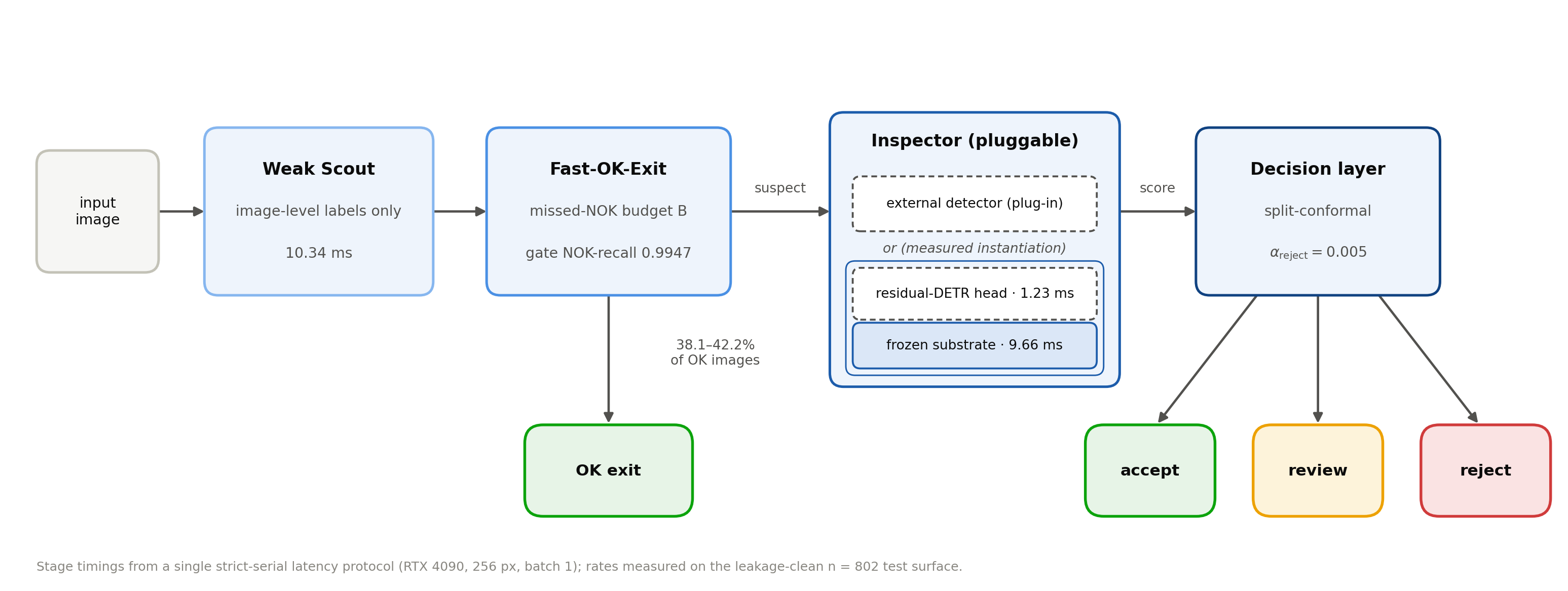
Figure 1 of the paper: weak scout, Fast-OK-Exit under a missed-NOK budget, pluggable inspector, conformal accept/review/reject layer.
Read the paper: Learning When Not to Inspect (PDF).
An image goes through three stages:
- Weak scout. A small image scorer (a DETR-style head over an ImageNet-pretrained ResNet-18) trained with binary cross-entropy on image-level OK/NOK labels only: no boxes, no masks. Its output is a score in
[0, 1], higher meaning more anomalous. - Fast-OK-Exit gate. An image whose scout score is below
tau_exitis accepted as OK at once and skips everything downstream.tau_exitis the largest threshold that keeps the validation NOK images wrongly let out within a missed-NOK budgetBthat you choose (for example 0 % or 1 %). - Inspector and decision layer. The other images go to the inspector, any function that maps an image to an anomaly score. A split-conformal layer turns the score into accept, review or reject, with thresholds taken from validation OK scores and a finite-sample bound on the rate of OK images rejected.
B, the strictness of the decision layer and the choice of inspector are all set after training: changing them means recalibrating on stored validation scores, not retraining. The repository does not ship an inspector: the cascade API takes yours.
Installation
git clone https://github.com/rosepetal-ai/rosepetal-research-selective-inspection.git
cd rosepetal-research-selective-inspection

python -m venv .venv
source .venv/bin/activate        # Windows: .venv\Scripts\activate
pip install -r requirements.txtThe package is not installed with pip: run its tools from the repository root as python -m selective_inspection.<tool>, or put the root on PYTHONPATH to import it.
Requirements
- Python 3.10 or newer.
- The packages of
requirements.txt:torch>=2.0,timm>=0.9,numpy>=1.24,pyyaml>=6.0,pillow>=9.0,onnx>=1.14,onnxruntime>=1.15. For a PyTorch build that matches your CUDA version, follow the PyTorch installation guide. - A CUDA GPU for training; on the CPU, training is only practical for smoke tests. Inference runs on the CPU (PyTorch or ONNX Runtime) or the GPU.
- Network access the first time a model is built with
pretrained: true(the default):timmdownloads the ImageNet weights of ResNet-18 once.--no-pretrainedskips the download for smoke runs. - Your own images. No dataset is included; the paper uses MVTec AD, which you download from its official page.
Documentation
| Page | Contents |
|---|---|
| Data and training | The manifest format, building splits, the synthetic dataset, the training recipe and its options, how many NOK labels you need, fine-tuning |
| Calibration | The exit-gate rule, the conformal decision layer, their output files, realised test rates, running the thresholds in production |
| Inference and deployment | Preprocessing, scoring with PyTorch, ONNX export and parity check, the cascade API with your own inspector |
| Paper results | What the paper measured, under which protocol, and what this repository can reproduce |
Usage
The tools pass their results on as files (a checkpoint, JSONL scores, JSON thresholds), so the steps below chain through files under runs/.
Data
Each split is a JSONL manifest, one image per line, with its path and an ok or nok label:
{"image_path": "images/train/part_0001.png", "label": "ok"}
{"image_path": "images/train/part_0002.png", "label": "nok", "image_id": "part_0002"}You need three disjoint manifests, train.jsonl, val.jsonl and test.jsonl, each with OK and NOK images: validation NOK scores calibrate the gate and validation OK scores calibrate the decision layer. Data and training has the full format and how to build the splits for MVTec AD.
To try the whole chain without a dataset, generate a small synthetic one and train for 20 steps:
python examples/make_dummy_dataset.py --out data/dummy
python -m selective_inspection.train --config configs/train_default.yaml \
    --train-manifest data/dummy/train.jsonl --val-manifest data/dummy/val.jsonl \
--max-steps 20 --batch-size 4 --device auto --out runs/smokeTraining
configs/train_default.yaml holds the paper's recipe (ResNet-18 at 256×256, 1500 steps, batch size 16, AdamW with learning rate 1e-4, seed 1337):
python -m selective_inspection.train \
    --config configs/train_default.yaml \
    --train-manifest data/my_dataset/train.jsonl \
    --val-manifest data/my_dataset/val.jsonl \
    --device cuda \
--out runs/scout_seed1337The run writes checkpoint.pt, predictions_val.jsonl (the validation scores the calibration reads), metrics_val.json (validation image AUROC) and resolved_config.json. It prints a warning when the training manifest has fewer than 200 NOK images: in the paper, the scout is close to chance with 50 NOK labels or fewer.
Calibration
Both thresholds are calibrated on the validation scores only:
# Exit gate, for missed-NOK budgets of 0 % and 1 %
python -m selective_inspection.calibrate_gate \
    --val-predictions runs/scout_seed1337/predictions_val.jsonl \
    --budget 0.0 0.01 \
    --out runs/scout_seed1337/gate.json

# Accept/review/reject layer
python -m selective_inspection.calibrate_conformal \
    --val-predictions runs/scout_seed1337/predictions_val.jsonl \
    --alpha-accept 0.10 --alpha-reject 0.005 \
--out runs/scout_seed1337/conformal.jsonCalibrate the decision layer on the validation scores of the model whose score it will judge: the inspector's in a real cascade, the scout's in the demo below.
Evaluation
Score the test split once, then pass it to the calibration tools with --test-predictions: the thresholds stay those of validation, and the JSON adds the rates they give on the test images, without any adjustment.
python -m selective_inspection.infer --checkpoint runs/scout_seed1337/checkpoint.pt \
    --manifest data/my_dataset/test.jsonl --out runs/scout_seed1337/predictions_test.jsonl

python -m selective_inspection.calibrate_gate \
    --val-predictions runs/scout_seed1337/predictions_val.jsonl \
    --budget 0.0 0.01 \
    --test-predictions runs/scout_seed1337/predictions_test.jsonl \
    --out runs/scout_seed1337/gate.json

python -m selective_inspection.calibrate_conformal \
    --val-predictions runs/scout_seed1337/predictions_val.jsonl \
    --test-predictions runs/scout_seed1337/predictions_test.jsonl \
--out runs/scout_seed1337/conformal.jsonFinally, run the cascade over a manifest. The demo has no inspector: routed images are judged on their scout score.
python -m selective_inspection.pipeline --checkpoint runs/scout_seed1337/checkpoint.pt \
    --gate-json runs/scout_seed1337/gate.json --budget 0.0 \
    --conformal-json runs/scout_seed1337/conformal.json \
--manifest data/my_dataset/test.jsonl --out runs/scout_seed1337/decisions.jsonlTo plug in a real inspector and deploy the scout as ONNX, see Inference and deployment.
Results
The paper measures everything on MVTec AD, with all 15 categories re-carved into its own label pools and one shared held-out test set of 802 images (614 OK, 188 NOK); thresholds are calibrated on a validation set of the same composition. As the paper notes, only its label-free baseline is comparable with the original unsupervised MVTec AD leaderboard.
- Exit. With a missed-NOK budget of 0 %, 38.1 % of the OK test images (234 of 614) exit before the inspector; with a budget of 1 % or less, 42.2 % (259 of 614). In both cases 187 of the 188 defective images are still routed to the inspector (exit-stage NOK recall 0.9947). These figures depend only on the scout and its calibration, not on the inspector. They come from a single training seed (1337).
- How many NOK labels. With the OK pool fixed, the scout's image AUROC is 0.512 with 50 NOK images (indistinguishable from chance), 0.860 with 200 and 0.9339 with the full pool of 727; at 100 it ranges from 0.569 to 0.810 across three training seeds. The paper advises collecting at least 200 image-level NOK labels.
- Cost. Under the paper's latency protocol (one RTX 4090, batch 1, 256 px), the exit lowers the mean cost per image by 15.1 % to 16.7 % and leaves the p95 latency unchanged (about 22.2 ms): it buys throughput, not latency.
The repository reproduces the scout, the gate and the decision layer. It does not include the paper's split manifests, the inspector used for the end-to-end measurements, the baselines or the latency harness. Paper results lists every measurement with its protocol and limits.
License
The repository's LICENSE file reads: "License: TBD by the authors."